
Acne Hyperpigmentation: How Long Until It Fades?

Today's summary
The approach to acne marks is completely different depending on whether it's built-up pigment or a scar where tissue has sunk in
Brown marks and red marks have different causes, so they're treated differently
Hyperpigmentation can fade over time, but that isn't true in every case
It's safest to start pigmentation treatment only after first checking how deep the mark is and what condition it's in

Hello, this is Datena Clinic.
"Will hyperpigmentation go away if I just leave it?" "I can't tell whether the marks on my face are pigment or scars."
These are questions we hear all the time during acne consultations.
Neither question has a single right answer.
That's because the answer depends on the mark's color, depth, and how long it's been there.
Rather than a promotional piece, today we want to walk you through how hyperpigmentation works, how it typically progresses, and when treatment becomes necessary, so that anyone struggling with acne marks can get a sense of where their skin stands right now.
Why do acne marks turn into hyperpigmentation?
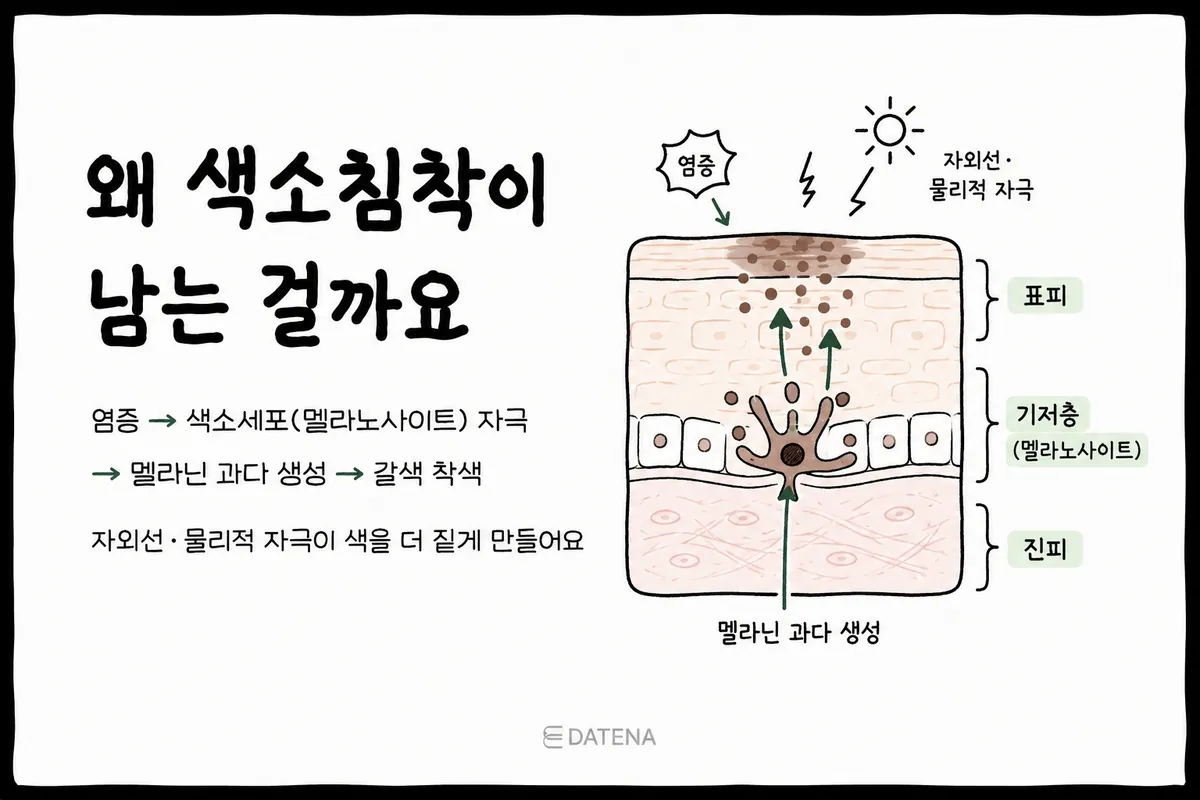
Acne is a condition where inflammation develops inside the hair follicle.
While the inflammation runs its course, the skin sets off a range of responses to repair the damaged tissue.
During this process, pigment cells called melanocytes in the basal layer of the epidermis get stimulated.
Stimulated melanocytes produce more melanin than usual, and as this melanin builds up in the epidermis and upper dermis, it leaves brown or dark marks behind.
This is called post-inflammatory hyperpigmentation.
Hyperpigmentation tends to be darker and last longer when physical irritation like squeezing or touching is added on top of the acne itself, and the longer the skin is exposed to UV.
It also tends to be more noticeable in people with darker skin tones or those whose skin reacts with especially strong inflammation.
Brown marks and red marks are actually different problems
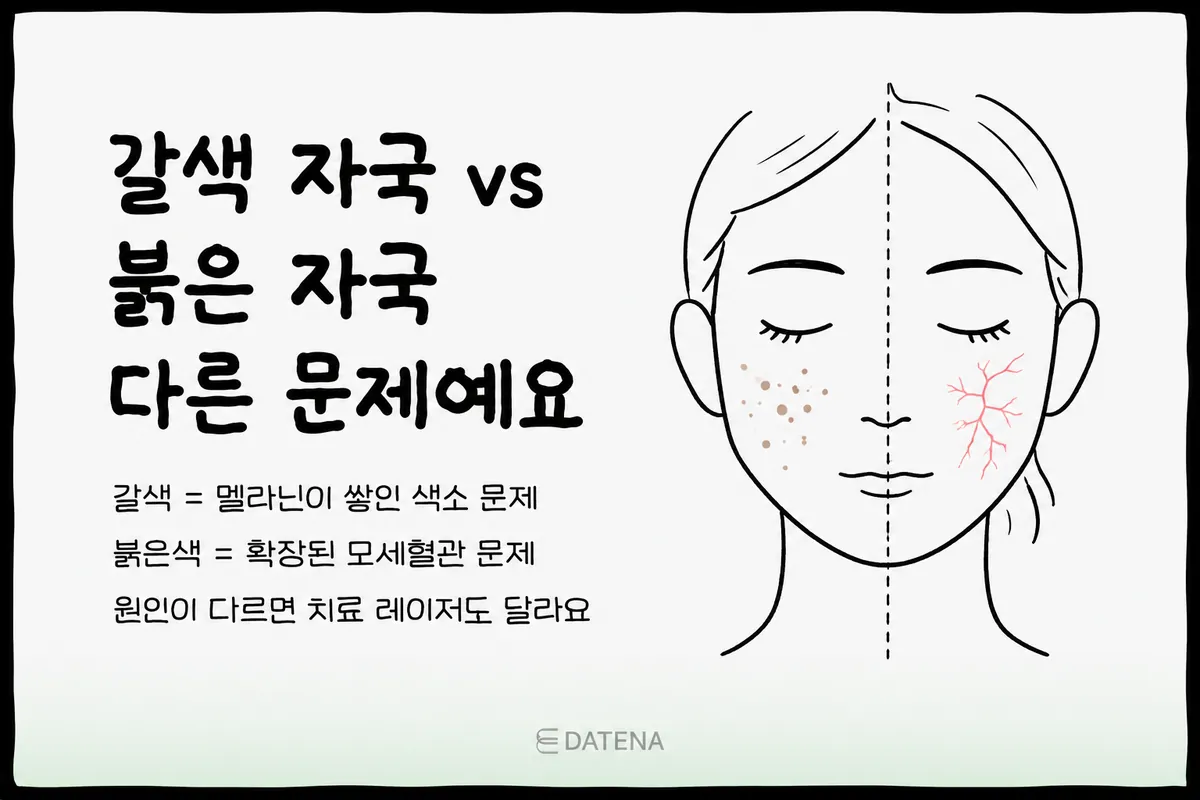
If you look closely at where acne used to be, the colors are sometimes different.
This difference in color isn't just individual variation; it's because something different is actually happening inside the skin.
As explained above, brown or dark marks are hyperpigmentation caused by built-up melanin.
If the pigment stays in the epidermis, it's relatively shallow hyperpigmentation; if it has moved down into the dermis, it's classified as dermal hyperpigmentation. Dermal pigmentation fades much more slowly than epidermal pigmentation.
Red marks, on the other hand, are often a blood vessel issue rather than pigment.
When capillaries dilate during inflammation and stay stretched afterward, the red vessels show through beneath the skin's surface, leaving a flushed-looking mark.
Because melanin isn't involved here, brightening creams or lasers that target melanin may be slow to make a difference.
If dilated vessels are the cause, the approach needs to shrink or break down those vessels.
Will it fade on its own over time?
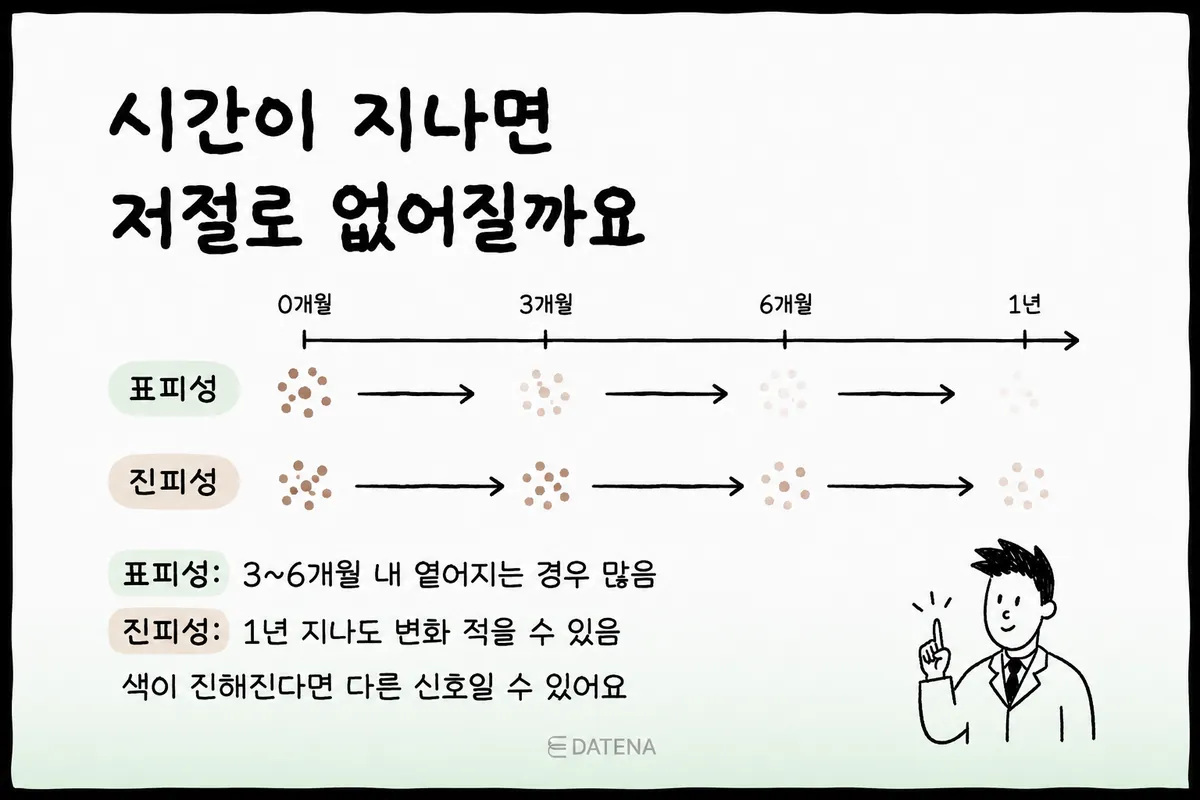
If the pigmentation sits in the epidermis (the outer layer), it can gradually fade through the skin's natural turnover, the cycle in which old surface cells are replaced with new ones.
Everyone is different, but it often fades noticeably within about 3 to 6 months.
During that time, diligent sun protection and avoiding physical irritation help the natural healing process go more smoothly.
The trouble comes when pigment has settled into the dermis.
The dermis doesn't renew as quickly as the epidermis, so once pigment lodges there, it may fade very slowly, or barely change at all, even after a year or more.
Also, if a mark has been there a long time but seems to be getting darker or its edges more defined, keep in mind that something other than simple pigmentation may be going on as well.
How is pigmentation treated?
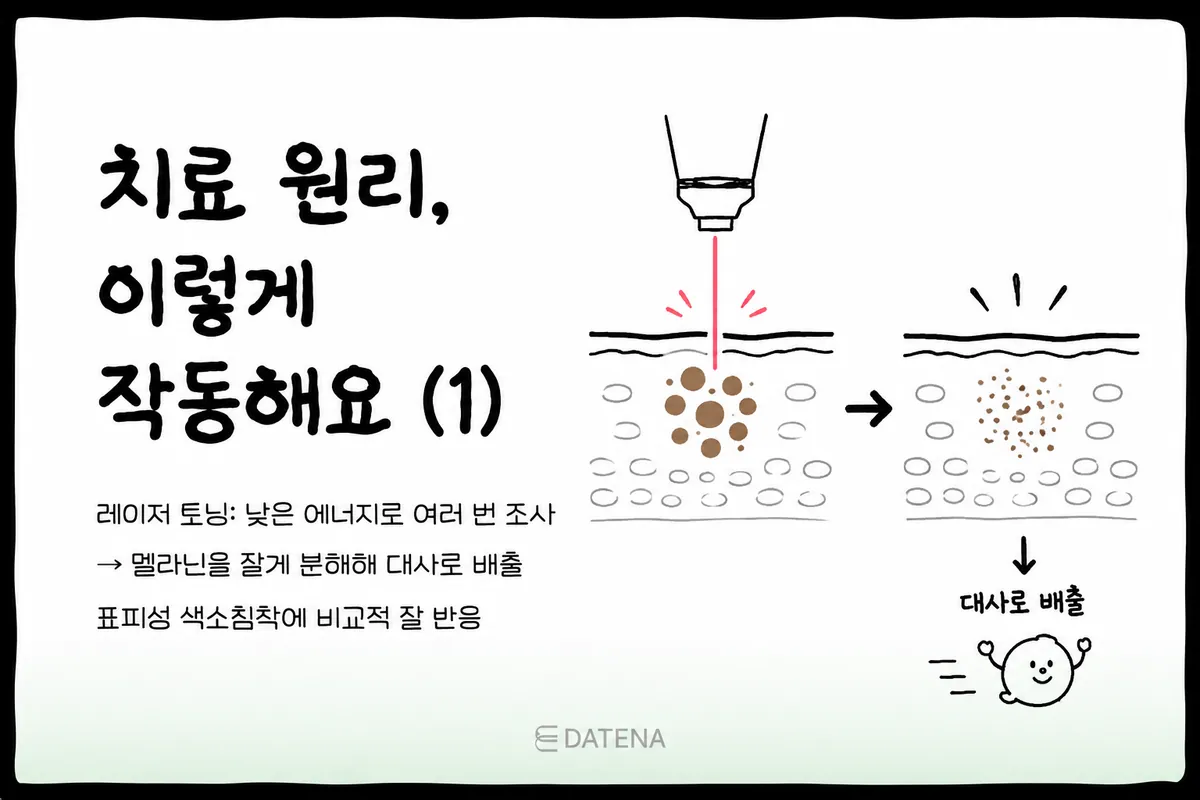
Treatment depends on the color and depth of the mark. Here's an overview of the main options and how they work.
Laser toning uses a 1064nm Nd:YAG laser, delivered at low energy over multiple passes.
The laser energy is selectively absorbed by melanin and breaks the pigment into tiny fragments, which the body then gradually clears through its natural metabolism.
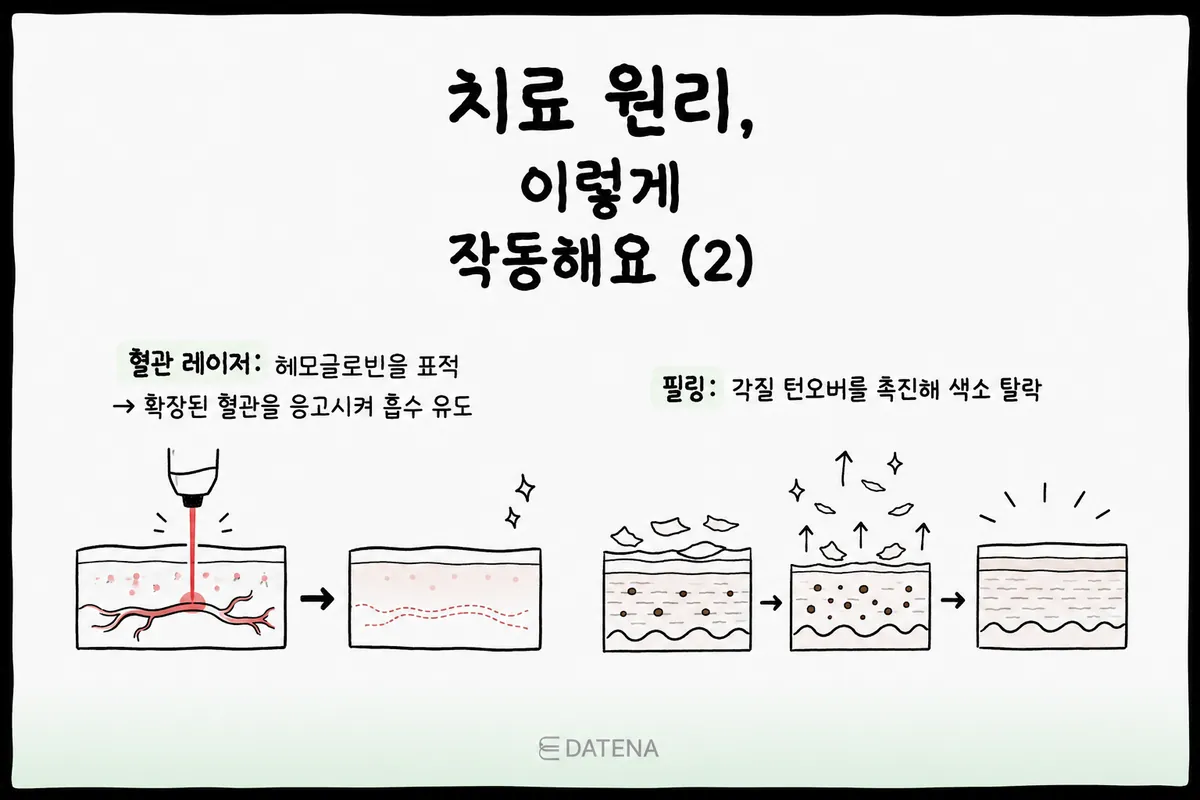
It tends to work relatively well for epidermal pigmentation.
For red marks, meaning vascular marks, we use a vascular laser that targets hemoglobin.
The dilated capillaries absorb the laser energy, which coagulates the vessel walls; the body then naturally reabsorbs those vessels and the redness fades.
Because this works on an entirely different principle from melanin-targeting lasers, repeating brightening laser treatments on red marks often brings slow results.
Chemical peels apply acids such as glycolic or salicylic acid to the skin to artificially speed up turnover of the outer layer.
The idea is that pigment sitting in the epidermis is shed along with the dead skin cells.
Its effect on pigment that has reached the dermis is limited.
Beyond these, treatment is often combined with topical brighteners that suppress melanin production itself, or with tranexamic acid delivered into the skin via iontophoresis.
Rather than relying on a single method, it's common to combine several approaches depending on the condition of the mark.
What if what looks like pigmentation is actually a scar?
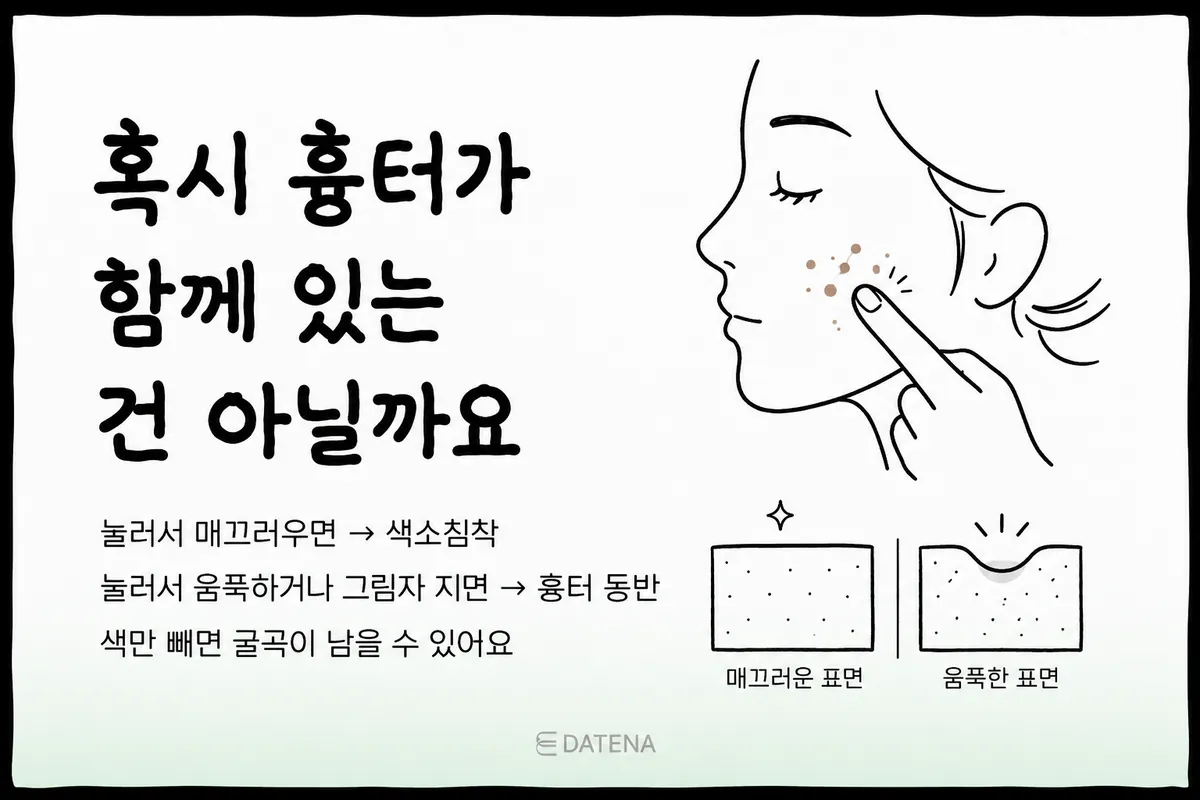
Pigmentation and scars may both look like "marks" on the surface, but what's happening inside the skin is completely different.
Pigmentation is a buildup of color, while a scar is a breakdown of the collagen structure in the dermis itself, leaving the surface indented or uneven.
If you gently press on the mark with your fingertip or stretch the skin to the side and the surface feels smooth, it's most likely pigmentation.
On the other hand, if it feels sunken when you press, or you can see a shadowed dip when light hits it at an angle, it points to tissue damage, meaning a scar, rather than pigment alone.
This distinction matters because the treatment plan is completely different.
For pigmentation, breaking down the pigment or speeding up turnover is enough, but scars need procedures that fill in the sunken dermis or release tethered tissue.
If you keep repeating pigment treatments and leave the scar untreated, we often see the color fade while the indentation stays exactly the same.
Things to check before treatment

Because the approach and expected timeline vary with the type of pigmentation, we recommend first getting a rough sense of your own condition using the guidelines below.
Type | Epidermal pigmentation | Dermal pigmentation |
|---|---|---|
Color | Relatively light brown | Dark brown to grayish brown |
Natural course | Often fades within 3–6 months | Little change even after a year or more |
Wood's lamp exam | Borders appear sharply accentuated | Borders look blurry or about the same |
Approach | Speeding up skin turnover, low-intensity laser toning | Multiple sessions of laser toning, combined with topical brightening agents |
As the table shows, even with the same kind of pigmentation, the expected timeline and the right approach can differ a lot depending on how deep the pigment sits.
It isn't easy to tell epidermal from dermal pigmentation with the naked eye, so checking first with a Wood's lamp or skin analysis device is the way to cut down on trial and error.
If post-acne pigmentation is bothering you, we recommend finding a clinic (it doesn't have to be ours) that first distinguishes pigmentation from scarring and checks how deep the pigment goes before recommending a treatment plan.
Starting treatment without pinpointing what's actually causing the marks rarely leads to results that justify the time and effort.
At Datena Clinic, the doctor examines your skin personally, and we take plenty of time on the diagnostic process, starting with telling pigmentation apart from scarring.
We believe the first step toward mark-free skin is knowing exactly what's going on with the marks you have now.
Medically reviewed by: Dr. Kang Dong-hyun (Datena Clinic) · Meet our doctors: /about.html