
Acne Scar Removal: Can Scars Be Completely Erased?
Today's summary
It's more realistic to aim for improvement rather than complete removal of acne scars
Scars and pigment marks have different causes and are treated differently
The right treatment depends on the shape of the scar (its depth and form)
Most cases combine several treatments rather than relying on just one
Hello, this is Datena Clinic.
Many people who have been bothered by old acne scars for years start researching treatments and wonder whether the scars can truly disappear.
Some even begin to doubt treatment altogether after hearing that people tried several procedures without getting the results they hoped for.
Because every acne scar differs in shape and depth, the same treatment can produce different results from person to person.
Today, we'll look at how far acne scar treatment can go and how treatment changes depending on the type of scar.
1. Can acne scars be completely erased?
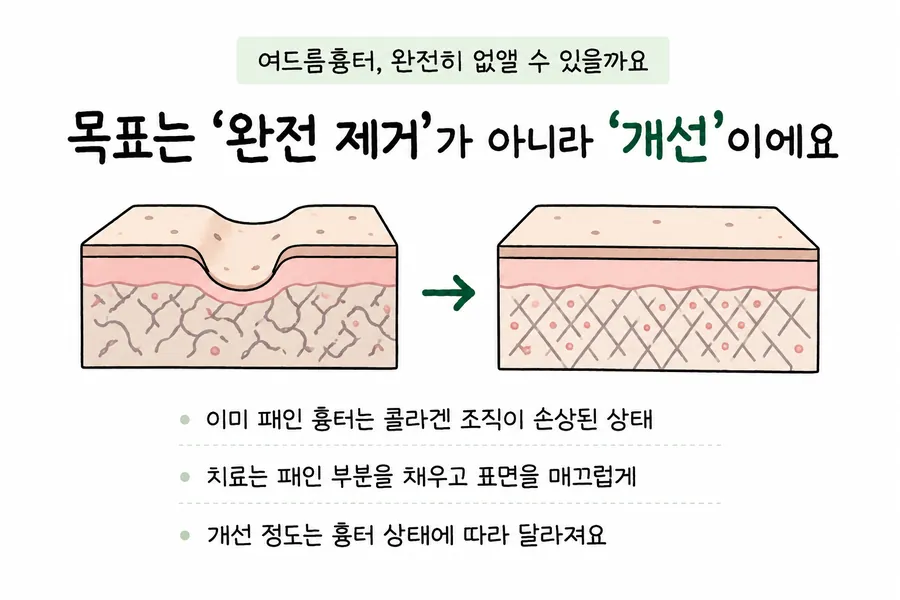
Once an acne scar has formed a depression, the collagen underneath is tangled and clumped together, so realistically, no treatment can return the skin exactly to how it was before.
The goal of treatment isn't to erase scars completely, but to fill in the depressed areas and smooth the skin's surface so the scars are much less noticeable.
How much improvement you see depends on the depth and extent of the scars, how long you've had them, and your skin's ability to regenerate.
Knowing ahead of time how much improvement you can reasonably expect also makes it easier to accept the results after treatment.
2. How are scars different from marks?
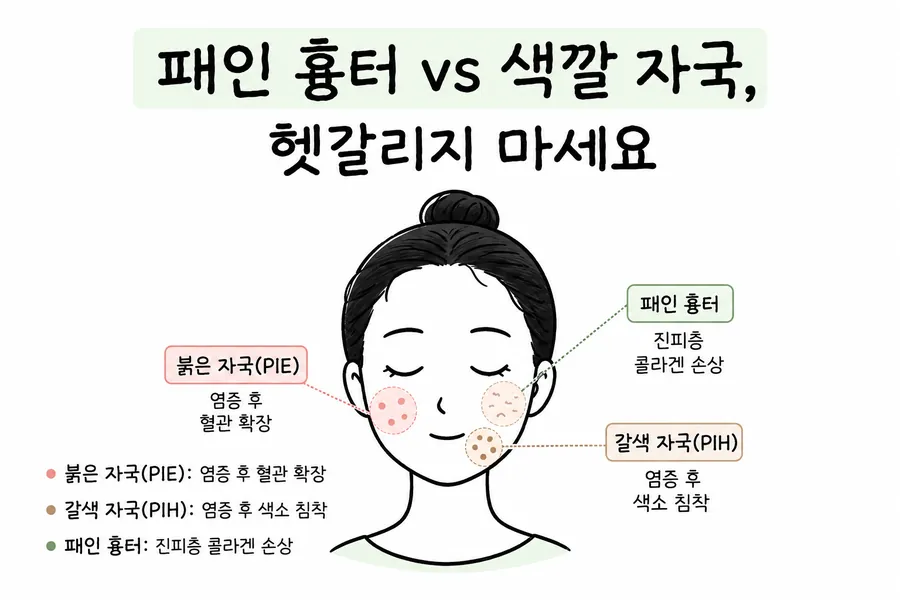
The traces acne leaves behind fall into two main groups: scars, where the skin's surface is sunken, and marks, which are only discoloration. The two have different causes and different treatments.
Red marks appear when inflammation dilates blood vessels, and brown marks form when melanin pigment builds up. Both can fade over time or with treatments that target pigment.
Depressed scars, on the other hand, result from damage to the collagen in the dermis, so unlike pigment marks they rarely recover on their own and often need in-clinic treatment.
It's important to tell them apart: some people mistake one for the other, rely only on pigment-care products, and miss the right window to treat their depressed scars.
3. Why treatment depends on scar shape
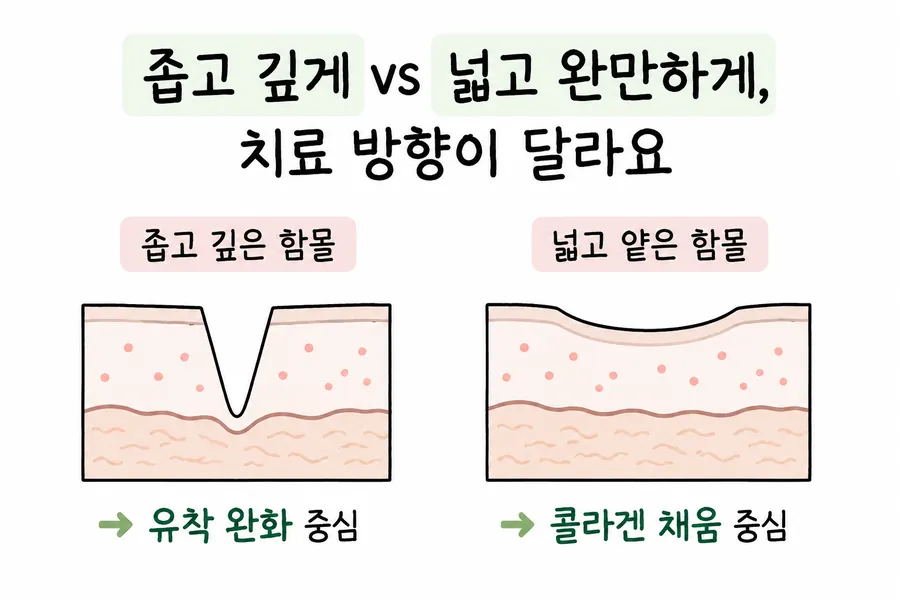
Depressed scars can be broadly divided by shape into narrow, deep scars and wide, gently sunken scars.
Narrow, deep scars are often pulled down tightly by fibrous tissue beneath the skin, so this tethering needs to be released first.
Wide, gentle scars are closer to an overall loss of volume caused by reduced collagen in the dermis, so treatment focuses on rebuilding that collagen.
If the scar type isn't identified accurately and only a single method is used, results may be limited.
Type | Shape | Treatment approach |
|---|---|---|
Narrow, deep scars | Sharp, narrow depressions | Focus on procedures that release tethering |
Wide, gently sunken scars | Broad, shallow depressions | Focus on procedures that rebuild collagen |
4. Treating narrow, deep scars
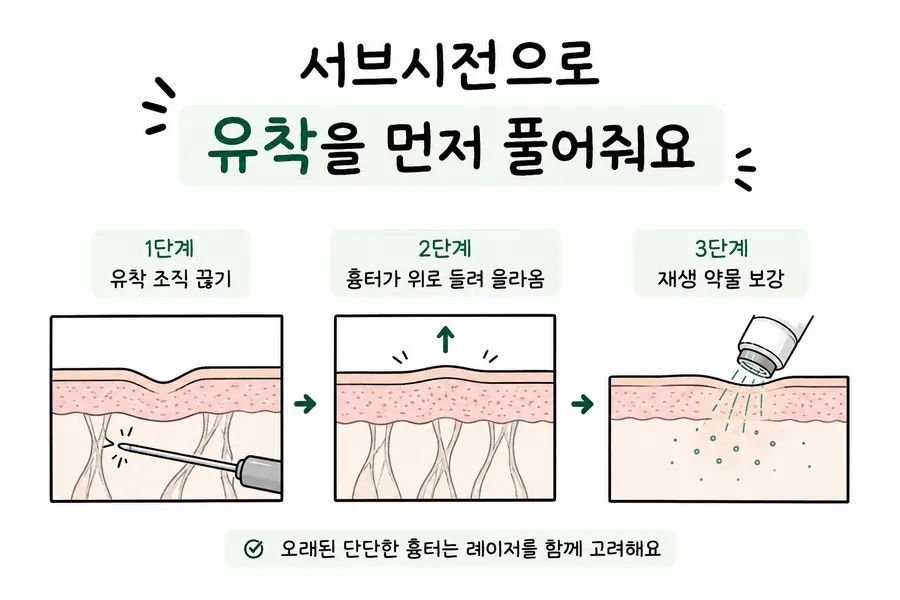
The go-to treatment for narrow, deep scars is subcision, which cuts the bands of fibrous tissue pulling the scar down from beneath the skin.
Once those fibers are released, the scar lifts up naturally, and a regenerative response is triggered that fills the space underneath with new tissue.
For narrow, deep areas that subcision alone can't fill, we may also use a needle-free device that delivers regenerative agents directly into the dermis under high pressure.
For older scars that have hardened, we may also consider using a laser to precisely resurface the scar edges.
5. Treating wide, gently sunken scars
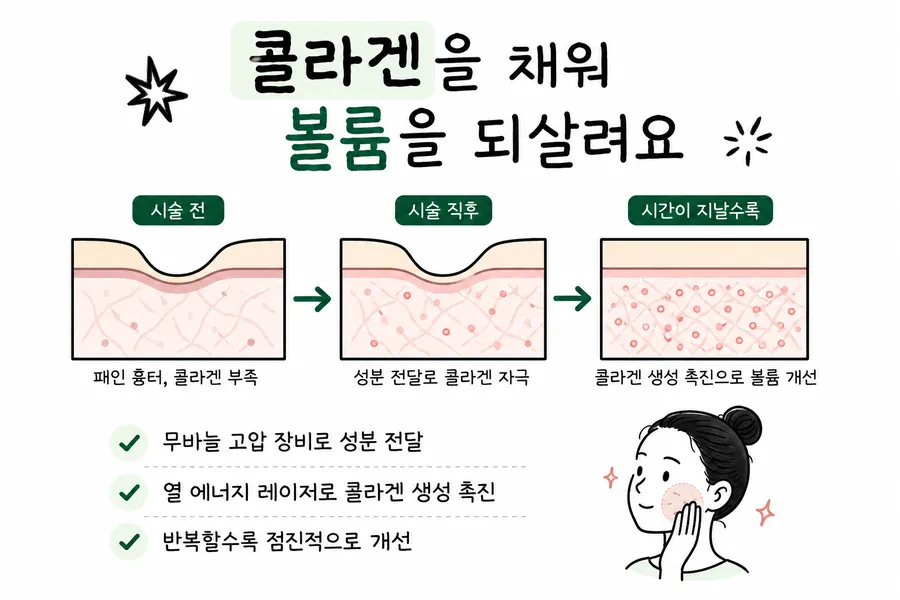
Wide, gently sunken scars reflect reduced collagen and lower overall density, so treatment centers on delivering ingredients into the dermis that help stimulate collagen production.
Needle-free devices like CureJet, which shoot agents into the skin under high pressure, can deliver ingredients relatively evenly even over large areas.
We may also combine this with procedures that create micro-stimulation on the skin's surface to boost absorption, or with lasers that heat the whole face to encourage collagen production.
Rather than a single session, collagen usually builds up gradually over several sessions spaced at regular intervals.
6. Why we combine multiple treatments
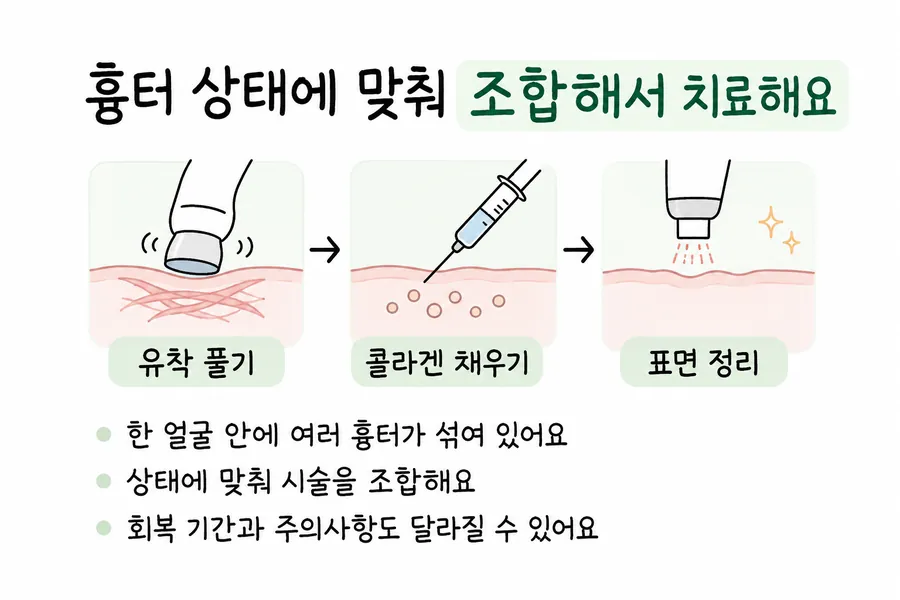
Most acne scarring doesn't show up as just one type; narrow, deep scars and wide, gentle scars are often mixed together.
That's why treatment often combines several approaches tailored to the scar: a procedure to release the tethering beneath the scar, one to rebuild collagen, and a laser to smooth the surface.
When several procedures are combined, the recovery time and aftercare instructions may differ from those for a single procedure, so it's important to go over the full treatment plan in advance.
Which procedures to combine, and in what order, depends on the shape and extent of your scars and the condition of your skin, so it's important to look at this carefully during your consultation.
It's realistic to think of acne scar treatment not as erasing scars completely, but as a process of making them less noticeable with treatment matched to each scar's shape.
Even similar-looking scars can call for different treatments and a different number of sessions, depending on their shape, depth and the condition of your skin.
At Datena Clinic, the doctor personally examines your scars and then works through the right combination of treatments with you, based on the shape of your scars. We consider that process essential.
Medically reviewed by: Dr. Kang Dong-hyun (Datena Clinic) · Meet our doctors: /about.html