
Acne Scar Treatment Intervals: Why Does Your Skin Need a Set Recovery Period?
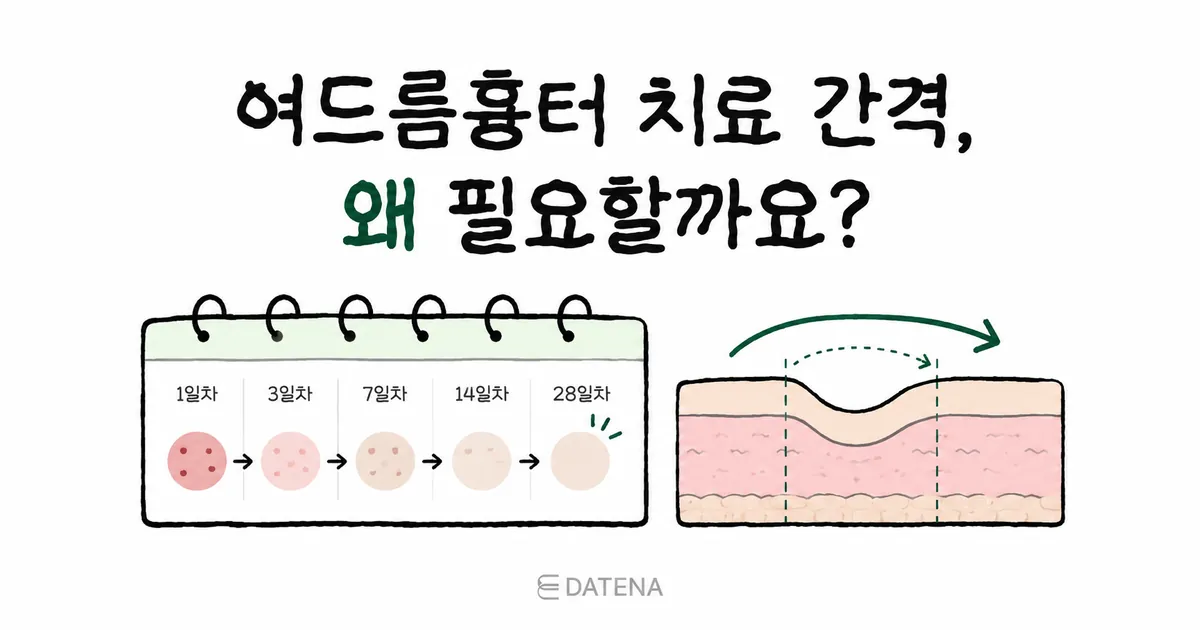
Today's summary
The interval between treatments depends on the type of procedure and how quickly your skin recovers
Getting your next treatment before your skin has recovered can actually make irritation worse
Even with some redness remaining, whether to proceed can depend on your skin's condition
If you have an important event coming up, it's best to consult with us ahead of time with recovery time in mind
"How far apart should scar treatments usually be?"
"My skin doesn't seem fully recovered yet. Is it okay to get my next treatment?"
I hear questions like these often.
Hello, this is Datena Clinic.
Most scar treatments work by deliberately creating tiny injuries or a mild inflammatory response in the skin, which then triggers collagen regeneration.
That's why skin right after a procedure shouldn't be seen as "done"—it has only just begun the process of healing and regenerating.
The timing of your next treatment is decided after checking how far that recovery has progressed. Today, let's walk through the criteria we use, one by one.
1. Typical Intervals for Scar Treatment
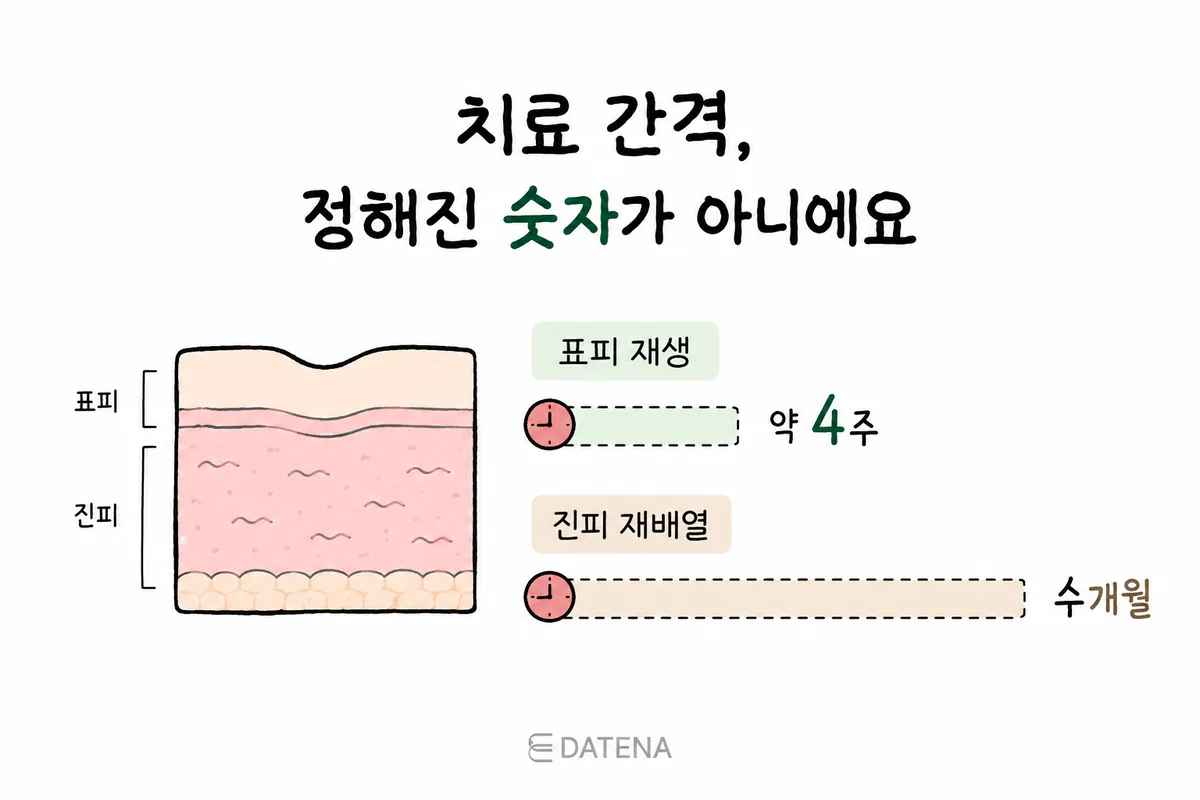
It's hard to give a single number for how far apart scar treatments should be, but there is a general pattern.
The epidermis (the outer layer of skin) typically renews itself on a cycle of about four weeks, and this cycle serves as the minimum benchmark when setting intervals for procedures that mainly target the surface.
Collagen in the dermis, on the other hand, is known to change gradually over several months—even after it's newly produced—before it settles into a stable structure.
For this reason, treatments that reach deep into the dermis are sometimes spaced anywhere from 4 weeks to 8 weeks or more apart.
So the most accurate way to think about it: the interval isn't one fixed value, but a wide range that depends on how deep the procedure reached.
2. Why Intervals Differ by Procedure
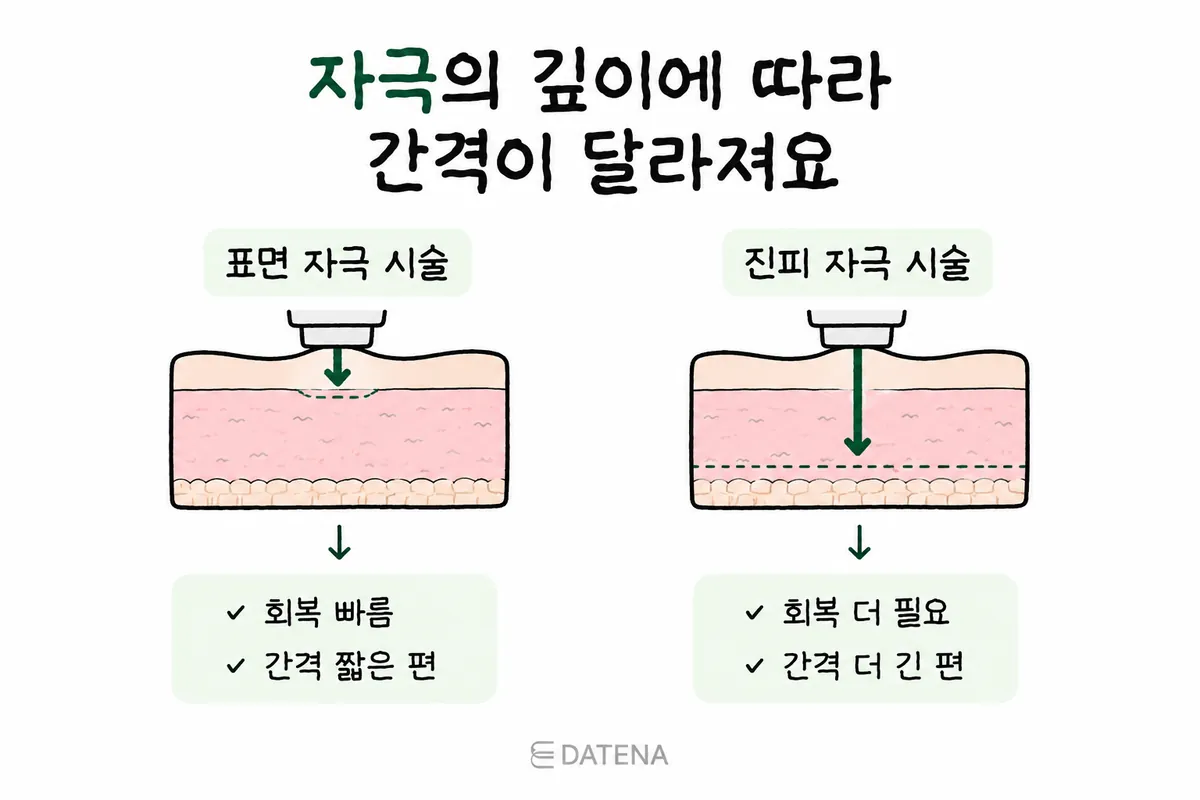
The biggest reason intervals differ between procedures is that each one affects the skin at a different depth and intensity.
Procedures that deliver fine stimulation mainly to the epidermis tend to heal relatively quickly, so their intervals are usually shorter.
In contrast, procedures that deliver heat or physical stimulation into the dermis, or that directly release the fibrous bands pulling scars downward, require more time for the tissue to settle into its new form.
When several procedures are combined in one session, multiple layers are stimulated at once, so recovery often takes longer than with a single procedure.
In short, the interval depends less on the name of the procedure and more on how deep into the skin it reached and how strong the stimulation was.
3. The Risks of Retreating Before Recovery
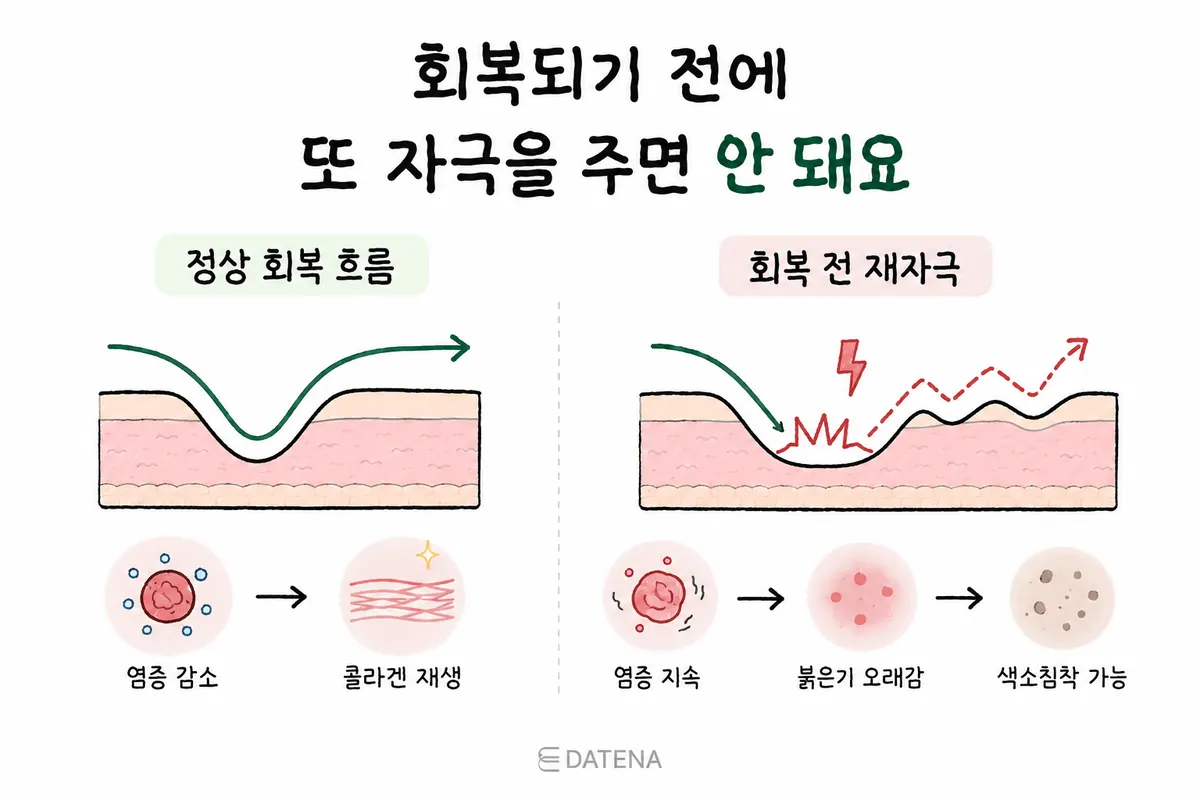
Adding new stimulation before the skin has recovered can actually lead to the opposite of what you want.
In normal healing, inflammation gradually calms down and leads into collagen regeneration. But if another round of stimulation is added before this process is complete, the inflammation can end up lingering excessively.
If this happens repeatedly, temporary redness or pigmentation may last longer than expected, and in rare cases, the scars may become more noticeable instead of improving.
Rather than moving your next session up on your own because you're eager to see results, the safe approach is to first confirm how much your skin has actually recovered.
4. What We Look At When Redness Remains
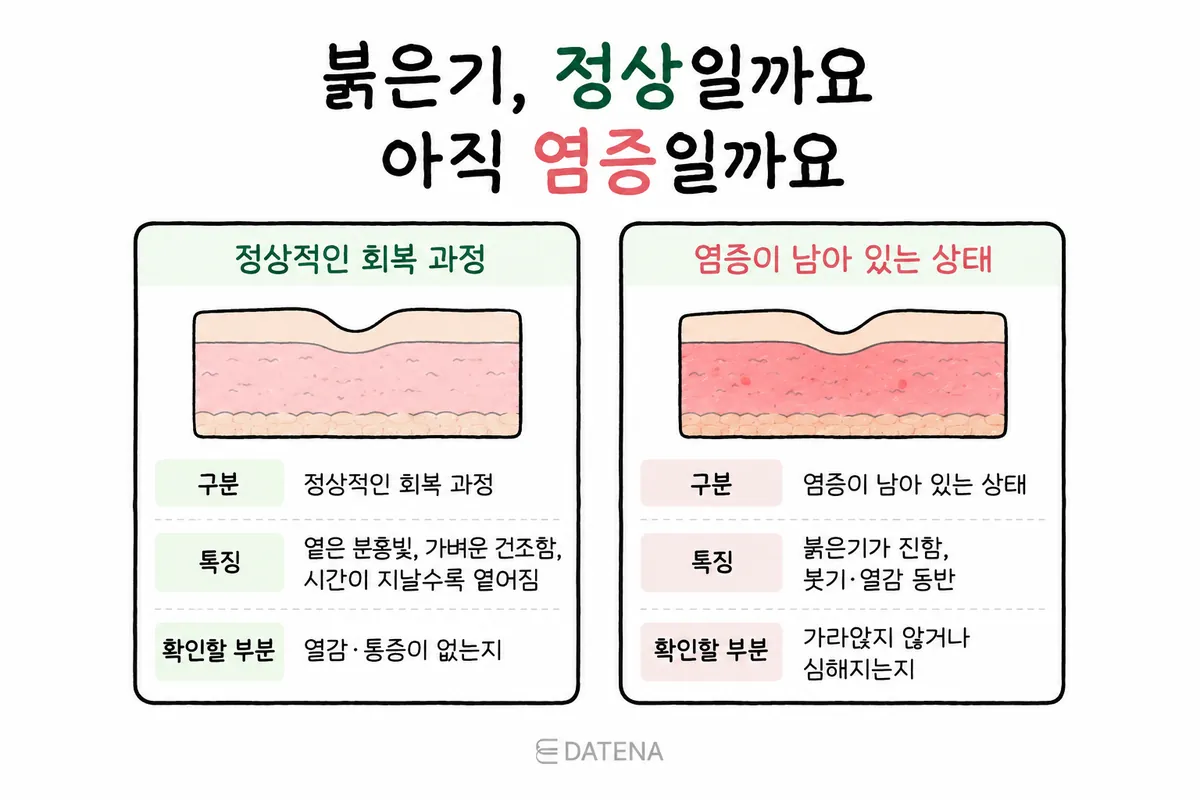
Remaining redness doesn't automatically mean your next treatment has to be postponed.
However, depending on what the redness looks like, it can mean either that healing is progressing normally or that inflammation hasn't yet settled down.
Let's compare the two cases in the table below.
Type | Characteristics | What to check |
|---|---|---|
Normal healing | A light pink tone with mild dryness that gradually fades over time | Check whether the area feels warm or tender to the touch |
Inflammation still present | Deeper redness, along with swelling or warmth | Check whether it fails to settle over time, or even gets worse |
If the skin feels warm or is still swollen when you touch it lightly, that can be a sign the inflammatory response is still underway, so the timing of your next session should be reassessed.
5. How we set your personal interval
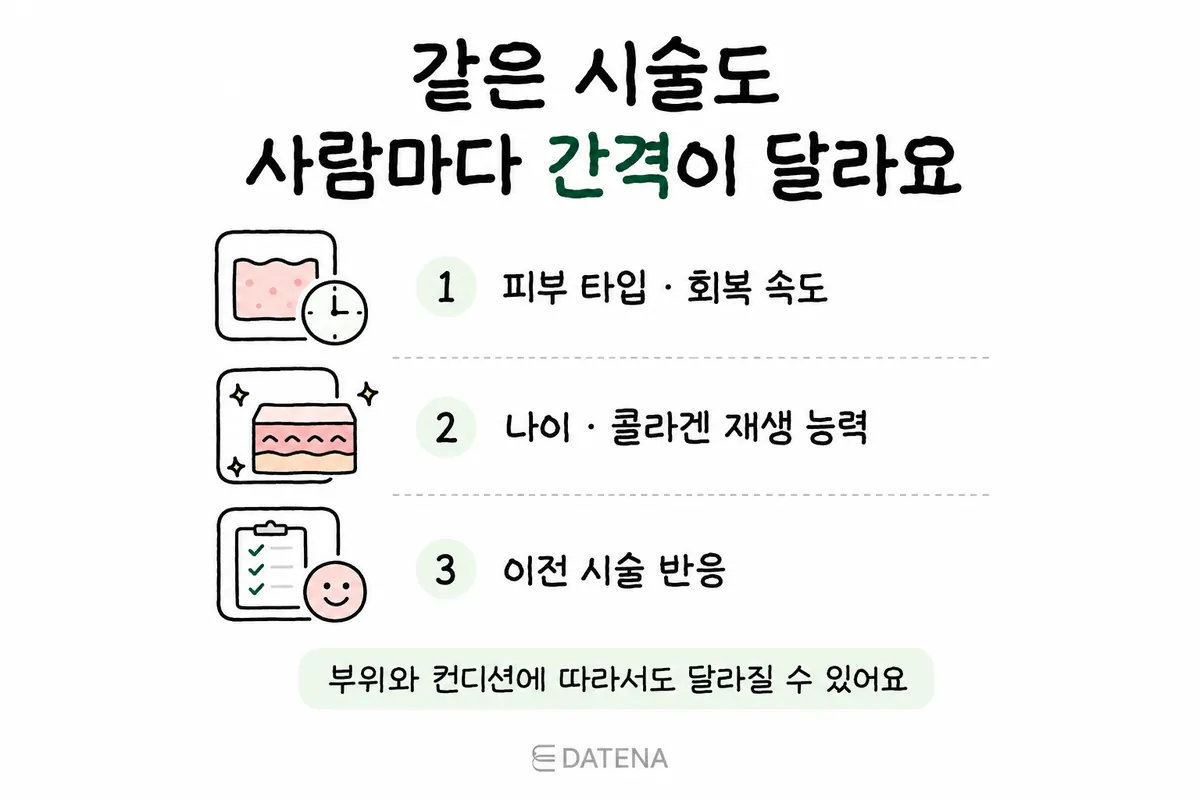
Even with the same treatment, the right interval can differ from person to person.
Your skin type, how quickly you usually heal, your collagen-regenerating ability (which changes with age), and how your skin reacted to previous treatments all play a role in setting the interval.
Even for the same person, healing speed can vary by treatment area or by how the skin is doing that day, so it's common to schedule the next session after checking the actual condition of your skin rather than going by a set date.
That's why treatment intervals are often adjusted session by session based on how you've healed, rather than given as a fixed number from the start.
6. When to come in if you have a big date coming up
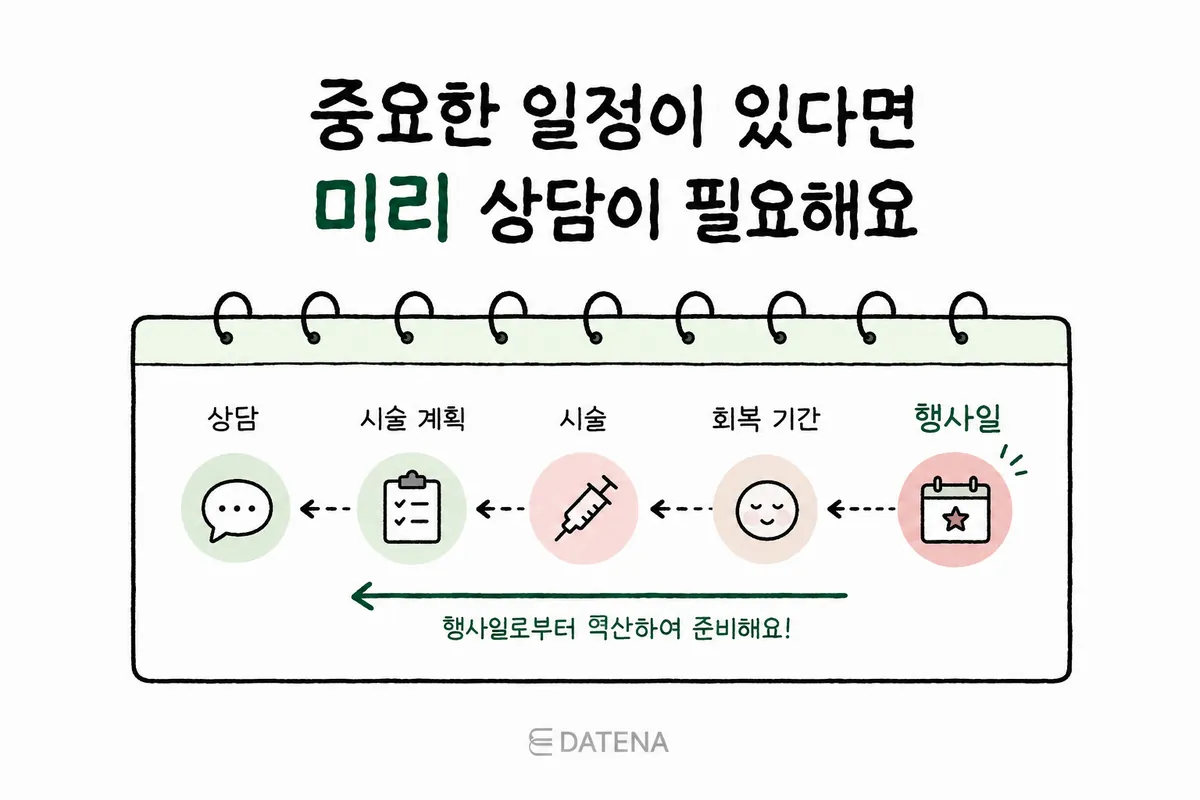
If you need to look your best on a specific date, like a wedding or another big occasion, it's a good idea to plan your treatment around it ahead of time.
Treatments that reach deep into the dermis often need several weeks to heal, so rather than starting right before the event, it's safer to come in for a consultation and work backward from the date, leaving plenty of recovery time.
For treatments that take multiple sessions, it helps to confirm during your consultation that there's enough recovery time between the full treatment schedule and your event.
On the other hand, even if you'd like to speed things up, pushing ahead before your skin has fully healed could actually affect how your skin looks on the day of the event, so please keep that in mind too.
Treatment intervals aren't a fixed formula. They're closer to a process, shaped by the type of treatment and how quickly your skin heals.
If you're wondering when your next session should be, the most accurate answer comes from checking your healing in person.
At Datena Clinic, when setting intervals for scar treatment, our doctors personally check how you've healed and decide on the timing of your next session together with you.
Medically reviewed by: Dr. Kang Dong-hyun (Datena Clinic) · Meet our doctors: /about.html