
Ulthera for smile lines: why we start by sorting out what makes them look deep

Smile lines that look deep don't all have the same cause, so what a lifting treatment can change differs from person to person. We separate cheek sagging, volume changes, and folds from expression and skin, and lay out what Ulthera can and can't do.
1. Where smile lines form
2. Shadows created by cheek sagging
3. Changes in volume and bone
4. Folds from expression and skin elasticity
5. What to expect from Ulthera, and its limits
6. Facial features and reactions to check before treatment
Today's summary
Smile lines are shaped by sagging, volume, and expression together.
Lifting focuses on changing the firmness of sagging tissue.
It can't really be expected to refill lost volume.
If your cheeks are thin, the treatment area needs to be chosen carefully.

Hello, this is Datena Clinic.
Smile lines (nasolabial folds) run from beside the nose toward the corners of the mouth, so they often lead to the worry that your face looks tired. People searching for Ulthera for smile lines often wonder whether lifting can soften this line. But the reasons smile lines look deep are a mix of cheeks that have dropped, lost volume, and folding when you smile. Today we'll look at how to tell these causes apart and how what you can expect from lifting changes depending on them.
1. Where smile lines form

A smile line is a fold that forms at the border between the cheek and the upper lip. Above this border sits cheek fat, and below it is where the muscles that lift the upper lip attach to the skin. When cheek tissue moves downward, it stops at the border where the muscles attach, and the tissue piles up above it, making the line stand out. So it's easier to understand a smile line not as a problem with the line itself, but as a visible result of changes in the tissue above and below it. Even at the same age, how visible this line is depends on the amount of cheek fat and the thickness of the skin.
2. Shadows created by cheek sagging

With age, the ligaments and fascia that hold the cheek tissue in place can loosen, and cheek fat can shift downward. In that case, tissue rests over the line beside the nose and casts a shadow even when your face is at rest. If you look in the mirror and gently pull the skin beside your cheekbone upward and the line fades noticeably, you can guess that sagging plays a large part. Sagging can also be more pronounced on one side, so it's good to check each side separately. That said, this is only a rough guide; the actual cause is assessed during a consultation along with the contours of your whole face.
3. Changes in volume and bone
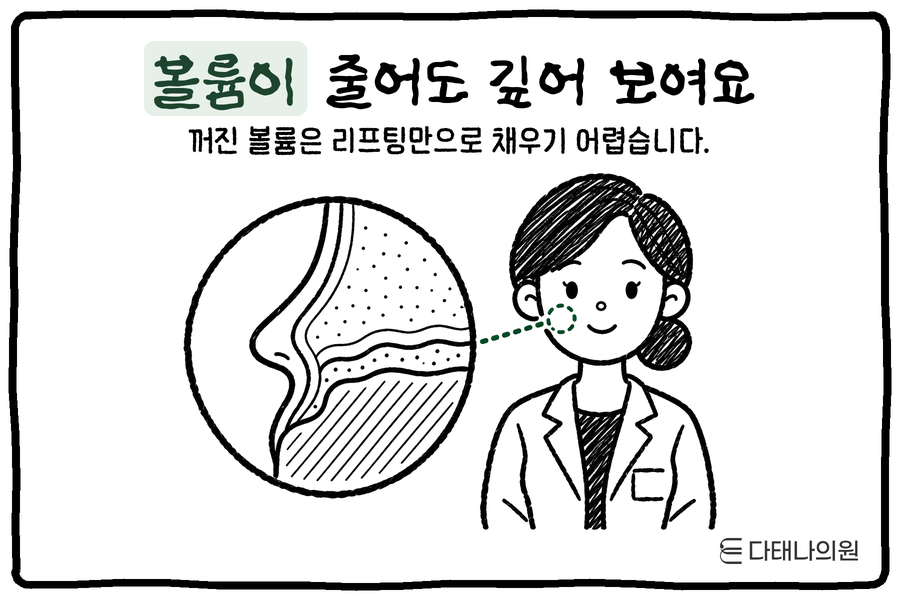
If your smile lines look deep even without much sagging, loss of fat in the front of the cheek may be a big factor. With age, the bone around the upper jaw also shrinks little by little, adding to the look of the area beside the nose having receded. In these cases, the front of the cheek looks flat or hollow, and the line doesn't change much even when you pull the skin upward. If your smile lines started looking deeper after significant weight loss, volume loss may also be part of it. Since lifting alone can't easily fill areas that have lost volume, it's important to distinguish sagging from volume loss.
4. Folds from expression and skin elasticity

If the line deepens only when you smile or talk and fades when your face is relaxed, facial muscle movement is a big part of the picture. When the muscle that lifts the upper lip moves again and again, the skin folds in the same spot over and over, and as skin elasticity declines, that fold tends to stay behind as fine lines. Observations that nasolabial folds nearly disappear on the side of the face affected by facial nerve paralysis hint at how much the muscles contribute. These folds are also natural lines that move with your expressions, so how much lifting can reduce them is limited.
Main cause | What you see in the mirror | Role of lifting |
|---|---|---|
Cheek sagging | Tissue overlaps the line even at rest | Some improvement possible |
Volume loss | Front of the cheek looks flat | Can't fill volume |
Expression folds | Deepens only when smiling | Limited |
Loss of skin elasticity | Fine lines around the fold | Superficial layers also considered |
5. What to expect from Ulthera, and its limits
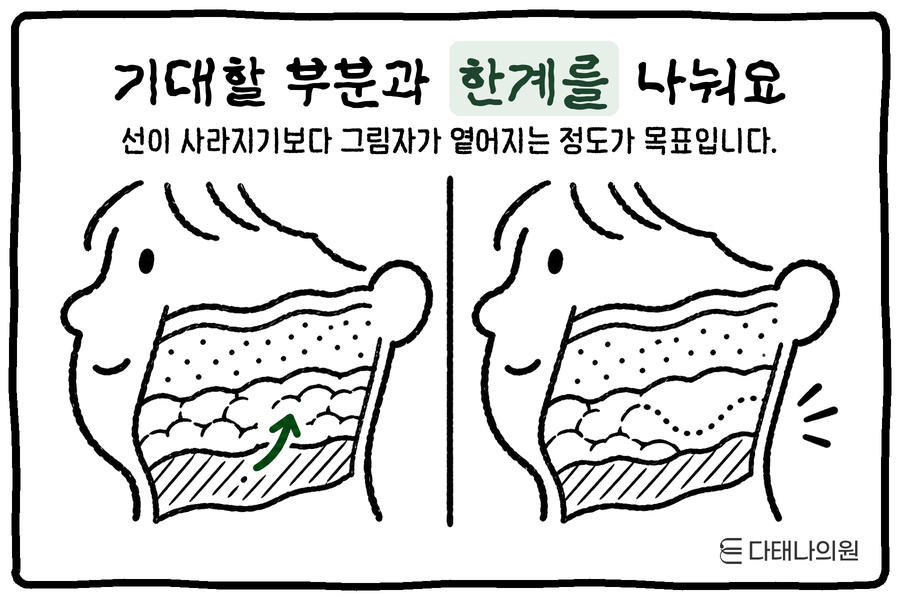
Ulthera creates tiny thermal coagulation points in the SMAS layer and dermis to encourage changes in the firmness of sagging tissue, so when cheek sagging is a major cause, you can expect the tissue sitting on top of the nasolabial fold to overlap less. That said, in the literature, improvement in nasolabial folds is mostly reported when combined with other treatments, so it's unrealistic to expect lifting alone to make the line disappear. Ulthera also can't be expected to fill areas that have lost volume or stop the folds created by facial expressions. If volume replacement is needed, a different type of treatment than lifting may be required, and that's something to discuss separately after the cause is assessed. A softer shadow, rather than a vanished line, is the more realistic goal.
6. Facial features and reactions to check before treatment

If your cheeks are naturally thin or the front of your cheeks is hollow, heavy deep-layer treatment there can make the hollowness more noticeable, so we choose the treatment area carefully. Let us know in advance if you have inflammation or wounds in the treatment area, a tendency to form keloids, or foreign material such as permanent fillers. If you've recently had other procedures or injections, it's a good idea to tell us when and where as well. After treatment, redness, swelling and tenderness to the touch can last a few days, and occasionally bruising or temporary numbness may occur. If movement around the mouth feels awkward or abnormal sensation on one side lasts more than a few weeks, it should be checked.
Wrapping up

How Ulthera changes nasolabial folds depends largely on why the line looks deep in the first place. Sorting out first whether cheek sagging, volume loss or expression folds play the biggest role lets you realistically separate what lifting can help with from what needs a different approach.
You can find details on our treatments and directions on the Datena Clinic official website.